When planning a direct mail campaign, one of the first decisions you need to make is surprisingly simple: what are you actually going to mail?
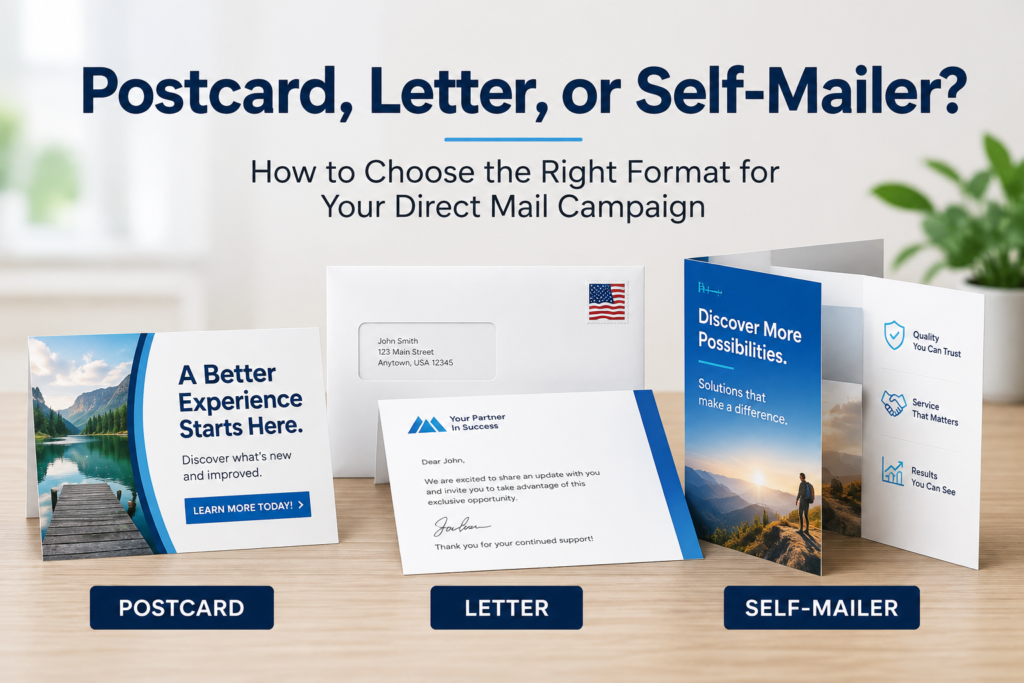
Postcards, letters, and self-mailers can all be effective marketing tools, but they work differently. The right choice depends on your audience, your message, your budget, and what you want recipients to do after receiving your piece.
There isn’t one format that’s always better than the others. A postcard might be perfect for announcing a sale but a poor choice for a detailed fundraising appeal. A letter gives you room to tell a story, but sometimes that’s more space than your message needs.
Here’s how to decide which format makes the most sense for your next campaign.
When a Postcard Is the Right Choice
Postcards are one of the simplest forms of direct mail, and that’s often their biggest advantage.
There is no envelope to open. Your headline, offer, and branding are immediately visible when someone picks up the mail.
That makes postcards particularly useful when your message can be communicated quickly.
A postcard may be a good choice for:
- Sales and special offers
- Event announcements
- Appointment reminders
- Grand openings
- New product or service announcements
- Customer reactivation campaigns
- Coupons and limited-time promotions
- Driving traffic to a website or landing page
The key is keeping the message focused. A postcard shouldn’t try to explain everything about your organization.
Instead, give the recipient one primary message and one clear next step.
For example, if you’re promoting an upcoming event, the postcard might include a strong headline, the date and location, a few key details, and a QR code or URL where recipients can learn more or register.
Postcards can also be cost-effective because they require fewer components than an envelope mailing. Depending on the size and mailing method, they may offer postage advantages as well.
However, the simplicity that makes postcards effective can also be a limitation. If your message requires a detailed explanation, emotional storytelling, multiple offers, or a significant amount of information, you may need more space.
When You Should Send a Letter
Sometimes you need to have a longer conversation with your audience.
That’s where a traditional letter package can be especially effective.
A letter gives you room to explain your message, tell a story, provide supporting information, and make a more detailed case for why someone should take action.
This is one reason letters remain popular with nonprofit organizations. A fundraising appeal may need to explain a need, share a story about the organization’s impact, and then ask the recipient to donate.
Letters are also useful when your communication needs to feel more personal or important.
Consider a letter for:
- Nonprofit fundraising appeals
- Membership renewals
- Important customer communications
- Personalized sales messages
- Detailed service introductions
- High-value offers
- Business-to-business outreach
- Messages requiring additional forms or inserts
The envelope itself also gives you options. You can include a reply envelope, donation form, brochure, buck slip, or other supporting materials.
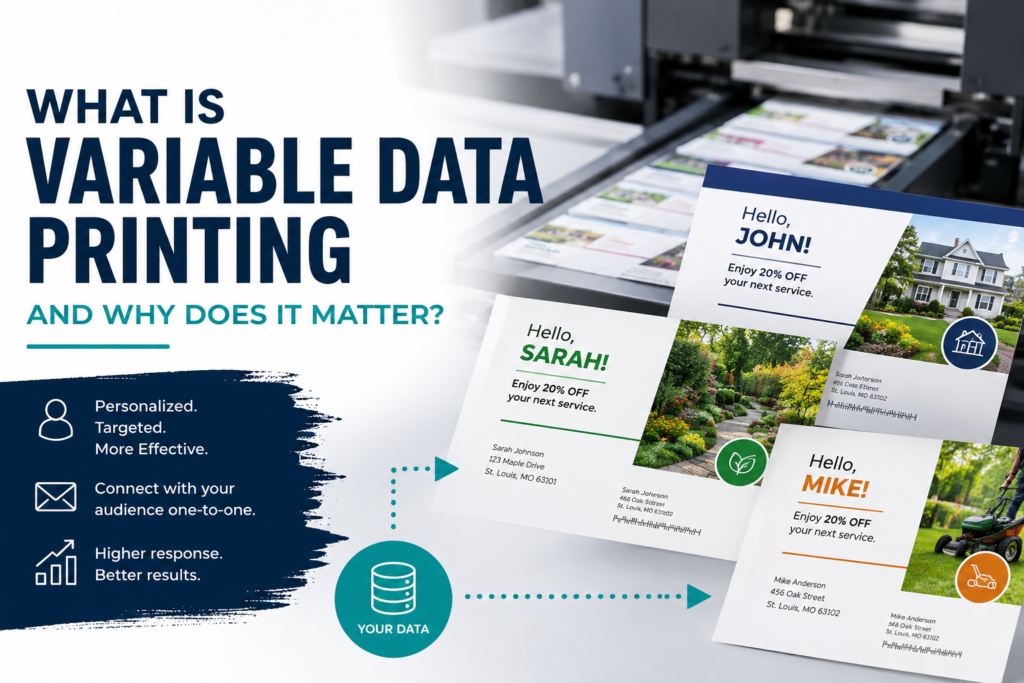
Personalization can make a letter even more effective. Instead of sending the exact same piece to every recipient, variable data printing can allow you to personalize names, offers, messaging, or other information based on your mailing list.
The tradeoff is that letter packages usually involve more components. More components can mean additional printing, inserting, and mailing costs.
That doesn’t make letters a poor value. It simply means they tend to make the most sense when the additional space and flexibility serve a purpose.
When a Self-Mailer Makes Sense
A self-mailer falls somewhere between a postcard and a traditional letter package.
Rather than placing the piece inside an envelope, the printed piece itself is folded and prepared for mailing.
This gives you more room to communicate than a standard postcard while still allowing recipients to interact with your message immediately.
Self-mailers work particularly well when visual presentation is important.
They can be a strong option for:
- Product or service promotions
- Retail campaigns
- Seasonal marketing
- Restaurant promotions
- Event marketing
- New customer offers
- Educational campaigns
- Programs that benefit from photos or graphics
Imagine a business that wants to introduce several services to prospective customers. A postcard may not provide enough room, while a full letter package may be unnecessary.
A folded self-mailer could provide a strong cover message, space inside to highlight several services, and a clear offer or call to action.
The design possibilities are another advantage. Different folds, panels, images, and layouts can guide the reader through your message in a specific order.
There are mailing requirements that need to be considered when designing self-mailers, including dimensions, folds, paper weight, and how the piece is closed. It’s best to account for these requirements before the design is finalized rather than trying to modify a finished piece later.
Start With the Goal, Not the Format
It’s easy to choose a format because you’ve used it before.
Instead, start by asking what you want the campaign to accomplish.
Are you trying to get someone to visit a website?
A postcard with a strong offer and QR code might be enough.
Are you asking a longtime donor to make an important year-end contribution?
A personalized letter may give you the space needed to make a stronger connection.
Are you introducing several products or services and want plenty of room for photos?
A self-mailer might make more sense.
The format should support the message, not dictate it.
Think About Your Audience Too
Your audience can be just as important as your campaign goal.
A mailing to existing customers may not require much explanation because recipients already know your business. A short postcard announcing a new service could work well.
A prospect who has never heard of your company may need more information before taking action.
The same applies to nonprofits. A longtime donor may respond differently to an appeal than someone receiving their first communication from the organization.
Segmenting your mailing list can even allow you to use different messages or formats for different groups.
Don’t Judge a Mailing by Printing Cost Alone
Budget matters, but comparing formats based only on printing cost can be misleading.
The least expensive piece isn’t necessarily the one that produces the best return.
Suppose a more detailed mailing costs slightly more but generates substantially more responses. That additional investment may be well worth it.
On the other hand, spending money on an elaborate letter package doesn’t make sense when a simple postcard could communicate the same message just as effectively.
Look at the entire campaign, including printing, postage, mailing preparation, response rate, and the potential value of each response.
Make the Next Step Obvious
Regardless of which format you choose, your direct mail piece needs a clear call to action.
Don’t make recipients figure out what they’re supposed to do next.
Tell them.
That could mean:
- Visit a website
- Scan a QR code
- Call your business
- Schedule an appointment
- Visit your location
- Register for an event
- Make a donation
- Redeem an offer
Whenever possible, make that action easy to complete.
A QR code can take recipients directly to a specific landing page. A personalized URL can help track responses. A dedicated phone number or promotional code can also help you measure campaign performance.
The Best Format Is the One That Fits Your Message
Postcards, letters, and self-mailers each have their place in a direct mail strategy.
Choose a postcard when you have a simple, attention-grabbing message and want recipients to see it immediately.
Choose a letter when you need room for storytelling, personalization, detailed information, or additional materials.
Choose a self-mailer when you want more space and visual flexibility without using a traditional envelope package.
Most importantly, think about the campaign as a whole. Your audience, mailing list, offer, design, timing, postage, and call to action all play a role in the results.
At Inkwell Printing Company, we help businesses and nonprofit organizations plan, print, and mail direct mail campaigns from start to finish. If you’re not sure whether a postcard, letter, or self-mailer makes the most sense for your next project, we can help you compare your options and find a format that fits your message and budget.
Contact us with any of your printing and direct mail needs!
For more helpful information check out our blog at: /advice-from-the-printer/
And for more information on Inkwell Printing Company check out our website at: www.inkwellstl.com